Finally Smallholder Tea growers have been given permission to engage a VSO Volunteer thanks to the hard-working spirit of Mr. Kasitomu - Association President. It took him courage and time to travel up and down to Lilongwe trying to convince those concerned.
When the first volunteer couple (Mike and Penny) left without prospects for their replacement, life became uncertain as to how the Smallholder Tea Farmers were going to manage the Fairtrade Premium and their projects.
Matthew Strickland (VSO) is now settling in and we strongly hope the Msuwadzi Association will now have the capacity to manage its projects as well as having the ability to link up with other agents in order to leverage their financial base.
In addition, he will also be assisting the Satemwa Joint Body in areas of project identification and management as this happens to be his area of specialisation.
For more log onto: www.satemwa.com
23 Feb 2010


11 Feb 2010
FAIRTRADE MEDIA PROJECT CO-ORDINATOR VISITS SATEMWA ESTATE
On Wenesday 27th January 2010, we received visitors from the Fairtrade Foundation who were on a fact finding mission with regards to the Fairtrade Media Project.
 Photo: Annete Muller demonstrating to JB women members
on how to take video clips using a cellphone
Annette Muller (Video and Digital Project Co-ordinator and team leader) was accompanied by Richard.
They met with Smallholder Tea growers and Joint Body members.
Among other issues, they advised us of the objective behind the project - To do stories and or capture clips that will give fairtrade consumers out there a true picture of the impact fairtrde is making towards changing people's lives.
Annette and Richard were stunned to note that Satemwa Joint Body is a step ahead in terms of communicating with the customers and other interested parties - by way of a blog onto which stories are posted.
They promised to link this blog with the Fairtrade facebook .
Photo: Annete Muller demonstrating to JB women memberson how to take video clips using a cellphone
For more info, visitthe website: www.satemwa.com
28 Sept 2009
Major water project underway
A major project has started to pipe clean water from the mountain down to various areas of Chizinja village, bordering Satemwa Estates.
Chizinja has approximately 4000 members. At present they have boreholes fro drinking water in some areas (2 supplied by the Fairtarde Joint Body) but many people are still taking water from the streams and other unprotected water sources.
The JB - in partnership with village Headwoman, Mai Chizinja, village committees, Thyolo Ministry of Irrigation Department and Irrigation Officers – have already started the preliminary stages of feasibility studies and topographic surveys. The team have found a water source high up close to the peak of the mountain. It is a natural spring producing significant enough quantities of water.
Earlier attempts to find water failed because the river banks are too eroded and the water is not clean due to people excreting in it further upstream. Natural springs and sources further down the mountain were also discounted because they are already a source of water supplies for other villages and farmers.
A major concern with drawing water from so high up the mountain is the tragic deforestation that has taken part over the last 10 years. What was a huge rainforest is now gone, replaced by smallholders growing Maize and bananas. This means that various streams and water sources are drying up in dry months and flooding in the rain seasons. Part of the water project will, therefore, require working very closely with the villagers to sensitise them to the importance of reforestation in the area above the spring. The area is, in part, already protected because there are 2 very large snakes living above the spring, preventing encroachers from other villagers planting that high.
Connex Banda and Rose Singhano, JB water project committee members, remarked “we walked all around the area and thought ‘ this is good because there are more trees and we have found water’ but that was because nobody had told us then about the huge snakes! We were lucky, but we also think these snakes could protect our water!”
Secondary School Bursaries
Satemwa JB have expanded their school bursary program from 50 to 117 students this term.
Students are accepted on a needs basis through the Joint Body Education sub-committee.
The project is managed by Rabson Kalowa, JB Chairman, personally to ensure the necessary administration is undertaken in time. Coordinating wit the schools and parents over such a large area, especially with poor communication channels available, has been very challenging.
The bursaries project, although successful and popular in the main, has not been without its challenges this year. Unfortunately, one headmaster has been found to have misappropriated the bursary funds for his own use. Issues around power and social standing make these kinds of activities very difficult for JB members to stand up to.
No more VSO on Thyolo mountain
The government Department for Human Resources and Management Development have written to Satemwa and Msuwadzi Smallholders tea growers advising them they cannot ‘employ’ a VSO volunteer to help them with capacity building and project co-ordination for their Fairtrade projects.
The government have explained that this job should be done by a local Malawian employee.
The current VSO volunteers working with the two organisations, Michael Shaw & Penny Hayler, are due to finish in October, in line with original contracts. They will not be replaced.
17 Sept 2009
6 New Teachers Houses get green light
Long term plans to build 6 new teachers houses for Satemwa school, a government primary school bordering Chizinja village, were given the final green light today by the JB board.
Under this ambitious project, the JB trust have taken out a long term lease for ‘peppercorn’ rent from Satemwa Ltd of 0.25 hectares of land in a central location bordering the shops and the school. The JB commissioned a land survey to demarcate the plot using GPS marker beacons. Following this the JB entered into a tender process with local and national contractors to find the optimum designs and best way of implementing such a large-scale project.
Pabe Civil Engineering and Building Contractors, from Blantyre, provided the winning bid. The project is planned to take 3 months and cost MK11.9million ($86,000) over 3 staged payments. The JB also negotiated penalty clauses with the technical assistance from Satemwa’s General Manager, Robert Emmott, to ensure the building works were completed in a timely manner.
The project has been in the pipeline for some years since members of Chizinja village started their own savings fund to build teachers houses. They have been concerned about losing some of their best teachers in the past into the cities due to lack of good teachers housing in the area. Parents are concerned that their children receive good tuition in English and have the best chance of winning places at secondary schools.
The school has benefitted from new teaching blocks , provided through Satemwa Tea Estate and the Tea Association, new desks, improved lighting and electrics and ecodome toilets (from the JB). In addition, higher teacher earnings from salaries through the adult literacy programme and the prospect of new housing is helping motivate teachers and keep the good ones in the area.
Satemwa school achieved record Standard 8 exam results and places for students into premium secondary schools this year.
10 Sept 2009
Compost making and water conservation projects
The initial JB project for training local farmers in compost making, soil & water preservation has been completed.
The DAO visited 14 villages to carry our sensitisation meetings and training to those farmers who requested it.
The JB have experienced some frustration with the project because the local government officers from the DAO have not accounted for their spending properly and seem to have used all the money for fuel benefits, contrary to the agreed budget and contract with the JB.
The JB have agreed to postpone any further projects with the help of this department and are trying to find ways of finding honest technical support within the local community.
1 Sept 2009
Adult Literary Schools – update
Satemwa JB adult literary schools have now entered their second term. Registered students have stabilised at 550, although during the harvest period and post growing season when seasonal workers leave the estate, the numbers dropped by around 100. However, the numbers have picked back up into this new term.
Satemwa’s headmaster noted this pattern is normal and the same is seen in the primary school.
School operates from 4.30pm to 6.30pm, Monday to Friday. Students can attend any of the four learning centres around the estate so long as they are a Satemwa worker or their spouse. Due to space restrictions and limited number of local teachers, the JB cannot open the schools up to the whole community of 36,000 people, although judging by the 30% take-up amongst Satemwa staff, there is a clear hunger for more learning.
There are now 21 teachers across the scheme and students ages range from 18 to 70 years old. However, some of the oldest lady students do not know their exact age.
Satemwa managers have noted that not only are the students hapy to be learning new skills like literacy, numeracy, English and life skills classes, but they are also more motivated at work. Mr Gomani, manager in STE coffee division suggested “some of my staff are starting to show more confidence now with writing, keeping records and reading English, but it is early days. I will make a study after one year”
10 Aug 2009
Kautuka CBO for People Living with HIV & AIDS
Satemwa JB have entered into a partnership with Kautuka CBO for supporting People Living with HIV & AIDS.
Kautuka is a village close to the road and around Thyolo No. 1 trading centre. The CBO is well organised with a drug dispensary, advisors and a support group. They receive technical assistance from time to time from Medicines Sans Frontier and government health officials, but resources remain very stretched.
Kautuka approached Satemwa’s General Assembly and Joint Body to ask if they could receive any assistance through the Fairtrade premium fund. Following 2 meetings, the JB have agreed to fund a 2 day training session for the Kautuka, by specialists on ‘Positive Living’ for people with HIV. The training included tuition on nutrition, growing vegetables, healthcare and community homecare support and other social elements.
The JB have also funded goats for the groups members which are being operated using a goat pass-on scheme, whereby each member must pass on the first Kid that is born from their goat to another member. The goats can be used for milk as well as meat to help with nutrition and income.
Finally the JB are funding the purchase of 3 bicycle ambulances with trailers and mattresses that have been made by a specialist company in Blantyre.

16 Jun 2009
JB partners with Thyolo District Agricultural Office
As part of the JB work plan to to improve rural livelihoods and food security in the villages around Satemwa, the JB have agreed a pilot project alongside the local District Agricultural Office.
Under the agreement, the DAO officers will be conducting workshops in each village to find out what their priorities are and to put together village-specific proposals that the JB could assist with using premium money and the assistance of the DAO experts.
Initial meetings have identified a project in Chizinja and Maonga village areas to pipe water from the mountain for drinking and irrigation. The villagers and village headwoman (Chizinja) have volunteered to dig the trenches, fetch river sand and provide other labour if the premium fund assists with cement, transport and water pipes.
Other projects so far include training in new compost-making techniques in three villages.

Village Headman addresses Mulenga village

DAO officer discusses ideas for projects with Mulenga village


15 Jun 2009
Fairtrade Auditor visits Satemwa
Satemwa Tea Estate, Satemwa Workers Joint Body and Msuwadzi Smallholder Tea Growers Association have all been audited by the Fairtrade Association during the first week of June.
FLO-CERT, the auditing division of Fairtrade, visited all the fields and divisions of the smallholder farmers and the estate. They also reviewed all of the paperwork and interviewed workers.
In the final meeting FLO-CERT auditor Kennedy Chakanyuka congratulated the JB on all their projects. He said they showed genuine development and the positive impact that Fairtrade premium, through the JB, has made to the area. He highlighted the 6 new local bridges, clean water and the adult education classes as ‘very encouraging. Quite moving, really'.
But he reminded everybody that things must still improve, pointing out problems with the Smallholders record keeping and business planning, overtime issues in the security division, and that the newly elected JB members need to understand more about how it works.
Msuwadzi Chairman, Wilfred Custom, observed “it was the first time most of our members have met these people from Fairtrade. We didn’t believe we would get this far. Many of the growers were afraid and did not speak out in our meeting. They always say they don’t know anything about this and that, when they do. Most of us, you see, we are illiterate. We need help with our business planning. We face so many problems”
A VSO volunteer, Michael Shaw, helping Msuwadzi comments “This is just the first step. They will need training and support to keep up with Fairtrade Standards, otherwise they are made ‘non-compliant’ and risk suspension. The problem is that these global standards are tougher year-on-year, including requirements for complicated business strategies and planning documents. It will take years to reach the ‘year 1’ standards for most Malawian members, especially those who are illiterate, so we are trying to talk to FLO about making these more appropriate. Fairtrade is very new to Malawi and people here are at different development stages to those in South America, for example. This is why the most disadvantaged farmers in Malawi are failing to benefit from Fairtrade. They produce good crops, but they are illiterate.”
11 Jun 2009
Solar brings music, light and money to Satemwa workers and communities
Satemwa JB have entered into a partnership with Kadzuwa, based in Mzuzu, Malawi, to supply 2000 micro solar panels, batteries and energy saving bulbs to help provide light and electricity to the workers and villages. Kadzuwa are supported and established by SolarAid, a UK based charity.
So far Kadzuwa, through their village assembly groups in the North, have supplied 550 panels. They are sending 200 more each month.
The JB buy the kits (MK5000 each) using workers fairtrade premium funds and then sell these at a subsidised price of MK1000 ($7) to the workers.
Next month, SolarAid are visiting to discuss setting up solar panel assembly groups in the local villages around Satemwa so local people can benefit from making small solar businesses in assembly, sales, spares bulbs and repairs.
The Solars are very popular. With one panel, workers can charge their mobile phones, light their houses every night and listen to their radios, for free.

using solar power to listen to the radio
Takondwa Banda, a part-time working mother from Chawani division, commented “I don’t pay for paraffin or batteries any more. It was MK1000 a month. I have more money. You see?”
Other workers are less sure. Smart Stimme from Factory division says “some are still waiting for their Solar. We are crying whether we can get them in time. We don’t know if they are coming?”
JB Chairman, Rabson Kalowa, responds “we are getting good price because they are being made by Malawians. But it means they take a longer time to come. These members [JB] and the General Assembly must explain to the workers that they should stop complaining. It will come. But we are many. They cannot understand.”
1300 workers are still due delivery. The JB estimate 3 more months to go.

Robert Muthete, JB member, demonstrating the low energy bulbs.
18 May 2009
Classes full at four Adult Literacy Schools
Following the success of the pilot project with Satemwa School, 3 further adult literacy schools have now opened in Mwalanthunsi, Chawani and Sabankhanga divisions. This ensures that all workers and their dependents from Satemwa have access to free evening classes.
550 workers are registered to date with over 70% attendance each day. Schools run from Monday to Friday, 4.30 – 7pm.
Satemwa Headmaster, overseeing the project, commented “the schools are very popular and the teachers are also happy. We have a high attendance even though it is harvesting time”. The JB currently employ 25 teachers to manage all the different levels of classes in each school. Some students are planning to write their Standard 8 exams next year. Others, including some grandmothers, are starting in Standard 1.
JB Vice-Chairman, Connex Banda, commented “there are parents studying Standard 1 ..and their grandchildren are in Standard 6, or 7. The children are helping them…the parents are happier now for the children to go to school, not staying in the village or helping in their gardens”
Satemwa Tea Estates management are helping the JB improve the schools by painting all the new classrooms.
Banda, discussing the latest school in Chawani, comments “we are carrying down new benches and desks each night until we can organise a watchman” . Satemwa’s main school already benefits from new desks donated by the JB.
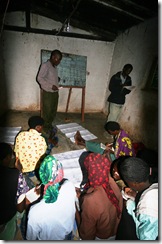
A standard 2 class at Chawani school opening night
12 May 2009
Water projects Update
The Joint Body have completed the first 12 boreholes and planned for a further 6 to be drilled, completing all compounds and villages around Satemwa.
Following a meeting with Chizinja village, a new project to pipe water from the mountain is in planning to help with safe drinking water and irrigation in the area.

11 May 2009
Satemwa sports kick off again with the Fairtrade Premiership

By popular demand the Joint Body purchased 6 sets of sports kits. 3 Netball kits and 3 football kits – giving each division area there own teams.
After a few weeks of training, the first matches were played yesterday, drawing hundreds of people to support and enjoy themselves at Satemwa Football and Netball grounds.
Final scores were:
NETBALL
| Mwalanthunsi | 1 |
| Satemwa | 12 |
FOOTBALL
| Mwalanthunsi | 2 |
| Satemwa | 0 |
Aside from the sports, people used the event to enjoy some music, dancing and socialising!

Satemwa Division Netball team

Mwalanthunsi Division Netball team

JB Chairman, Rabson Kalowa, greeting players

whoaaa…

Satemwa Division Football team

Mwalanthunsi Division Football team


a bit of dancing at half time

it was meant to say ‘fairtrade premium’…but now we have a name for the league..
Subscribe to:
Posts (Atom)

